Frequently Asked Questions

Below is a list of CAPA Frequently Asked Questions. Please contact us if you still have unanswered questions. 

CAPA

Open All Tabs
  • What is a Corrective Action (CA)?

    An action taken to address and correct identified non-compliance.

  • What is a Preventive Action (PA)?

    An action taken to prevent non-compliance from occurring or recurring by eliminating the root cause of a problem

  • What is a CAPA Plan?

    A plan that is developed and implemented to identify, remediate, and prevent recurrence or occurrence of existing or potential causes of non-compliance or other quality issues. A CAPA Plan is typically created in response to internal or external audits/Quality Reviews.

  • What is Root Cause Analysis?

    Root Cause Analysis (RCA) is a structured process for identifying “root causes” of problems or non-compliance. There are many approaches, tools, and techniques available to conduct a RCA. Two very common approaches are the “5 Whys” and “Fish-bone” diagrams.

  • Why Should we Conduct a Root Cause Analysis?

    Without knowing the root cause of a problem, you run the risk of only addressing or correcting the symptoms of a problem. Determining the root cause of an issue allows you to address the source of the problem and prevent its recurrence. When significant non-compliance is discovered by internal or external sources, the Principal Investigator/study team should perform a RCA and implement appropriate corrective and preventive actions. If there is more than one root cause identified (true in many cases) after conducting the RCA, all the causes should be addressed in the CAPA Plan for it to be successful. The RCA and CAPA Plan are considered successful when the problem or non-compliance does not recur.

  • What are Some Common Methods of Conducting Root Cause Analysis?

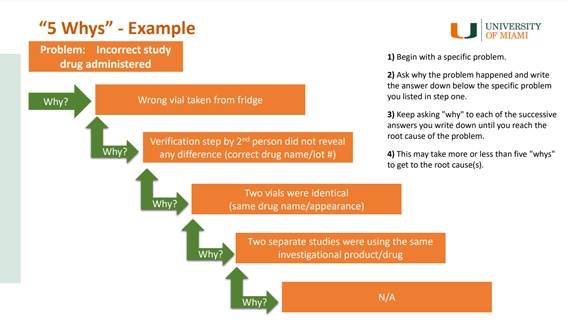
    5 Whys or Cause-and-Effect Diagrams: The “5 Whys" is an interrogative technique used to explore the cause-and-effect relationship underlying a non-compliance situation. The primary goal of this technique is to determine the root cause of a problem by repeating the question Why? (Why did this problem occur?) at least 5 times to identify the true cause of the problem. Each answer forms the basis of the next question. This technique forces you to think of several causes for a problem, instead of settling for the first cause that comes to mind. Please see link to 5 Whys or Cause-and-Effect Diagrams.

     5 Whys Image 

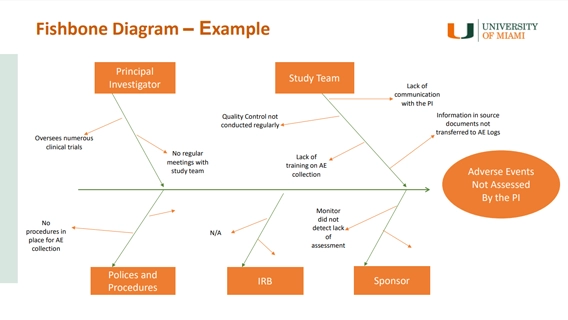
    Fish-bone/Ishikawa Diagrams: This technique visually displays the many potential causes of a specific problem onto a Fish-bone/Ishikawa Diagram. It helps facilitate the brainstorming of causes by grouping the causes into major categories to identify the source of variation or non-compliance. Please see link to Fish-bone/Ishikawa Diagrams.


    Fishbone Image


  • We Discovered Issues in our Department. Will RQA Help us Create a CAPA Plan?

    Yes, RQA is available to help research teams with the development, implementation, execution, and evaluation of CAPA Plans. Please contact RQA for CAPA assistance.

  • Do We Have to Involve RQA When Developing a CAPA Plan?

    It depends... Human subject research conducted at the University is routinely audited and monitored by internal and external entities. As part of these visits, non-compliance with federal, state, and local regulations or institutional policies may be identified. Depending on the severity of these issues, it may be required that a CAPA plan be created and implemented. RQA assists University researchers and their team with the creation and implementation of CAPA plans in response to internal or external audits/Quality Reviews. Please refer to the University of Miami Policy: Corrective Action Preventive Action (CAPA) Plans in Human Subject Research (policystat.com).

    Investigators and study teams are encouraged to contact RQA for CAPA Plans developed to correct non-compliance issues detected internally by the PI or study team. RQA is also available to support Investigators and study teams in the creation, implementation, and follow up of these CAPA Plans, if requested.

  • I Heard That Creating and Implementing a CAPA Plan Takes a Long Time. What Should I Expect?

    Every CAPA Plan is different in content and actions. The duration of a CAPA Plan depends on many factors, such as the severity of the non-compliance issues that need to be corrected and prevented, the risk level associated with them, the resources that each study team has, and the complexity of the clinical trial.

  • What is a CAPA Owner?

    A CAPA Owner is the main person responsible for the creation, implementation, and evaluation of a CAPA Plan. Typically, the PI is the CAPA Owner of a CAPA Plan created in response to an internal or external audit/Quality Review. For full CAPA Plans that are created to address systemic issues affecting several clinical trials, etc., the CAPA Owner may be Department leadership or anyone designated as the CAPA Owner.

  • Who is Responsible For Writing a CAPA Plan?

    CAPA Owners are responsible and accountable for the content and implementation of their CAPA Plan.

  • What Happens After a CAPA Plan is Written?

    After a CAPA Plan is written, all the corrective and preventive actions outlined in the CAPA Plan should be implemented in the timeframe documented in the CAPA Plan.

  • Does RQA Follow Up on Every CAPA Plan?

    RQA follows up on CAPA Plans created in response to internal or external audits/Quality Reviews.

  • What are Effectiveness Checks?

    Effectiveness checks are conducted to verify that the implemented actions of the CAPA Plan have addressed the non-compliance issues and that the issues have not recurred. If the non-compliance issues have recurred after the implementation of the corrective and preventive actions, the CAPA Plan should be revised and new actions should be implemented.

  • Should I Submit my CAPA Plan to the IRB?

    CAPA Plans created in response to internal or external audits/Quality Reviews should be submitted to RQA , who in turn will submit them to the IRB. 

  • Can I Send a Copy of my CAPA Plan to my Study Sponsor?

    It depends. CAPA Plans created in response to an internal Quality Review should not be shared with a Sponsor. CAPA Plans requested by the Sponsor or in response to Federal or other Governmental inspections, can be shared with the Sponsor of the particular study that was inspected, but only after the CAPA Plan has been reviewed by RQA and University leadership.

Top