Restricted Party Screening (RPS) is one component of the University's Know Your Collaborator approach. Researchers should consider requesting a screening whenever a new external individual or organization becomes involved in research, academic, or business activities. Research today relies on collaboration across institutions, sectors, and countries. Understanding who you are working with is an important aspect of responsible research practice. Restricted Party Screening helps support informed decision-making, identify potential compliance considerations, and promote a culture of responsible collaboration across the research lifecycle.

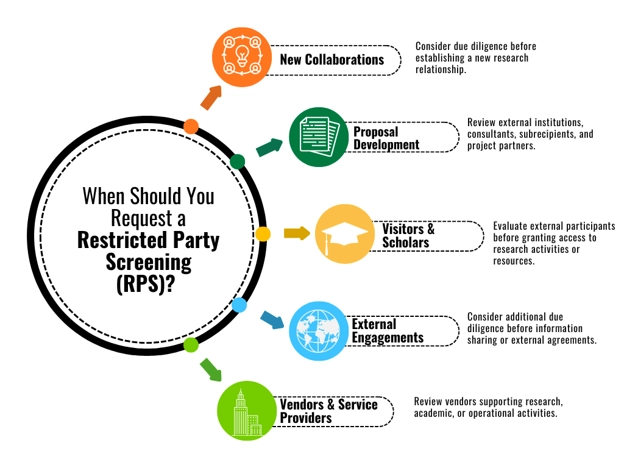
New Collaborations
When exploring a new research partnership, it is important to understand who you are working with, their institutional affiliations, and the purpose of the proposed collaboration. Early due diligence can help inform decisions before a formal relationship is established.
Proposal Development
Proposal development often involves external institutions, consultants, subrecipients, and other project partners. Considering due diligence at this stage can help identify potential compliance and research security considerations before project activities begin.
Visitors & Scholars
Visiting scholars, researchers, and other external participants may require access to laboratories, facilities, equipment, data, or research activities. Reviewing these individuals before access is granted can help support informed collaboration and resource access decisions.
External Engagements
Information-sharing discussions, non-disclosure agreements (NDAs), memoranda of understanding (MOUs), and other external engagements may warrant additional due diligence before moving forward. Screening can help researchers better understand the external parties involved in these activities.
Vendors & Service Providers
External companies and service providers frequently support research, academic, and operational activities. Evaluating these organizations when appropriate can help ensure that due diligence considerations are addressed before engagement.
Rule of Thumb: If a new external person or organization is entering your research ecosystem, consider whether collaborator due diligence and Restricted Party Screening may be appropriate.

Restricted Party Screening helps researchers conduct due diligence on external individuals and organizations before engaging in research, academic, or business activities.
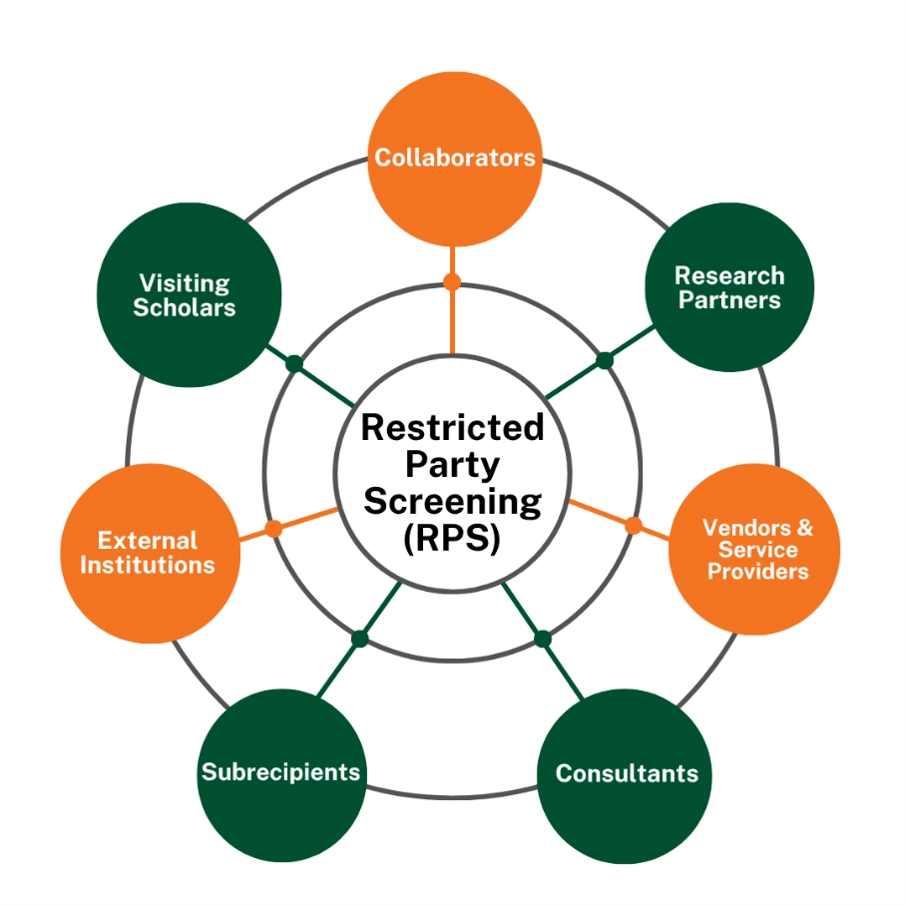
Restricted Party Screening may be conducted on a variety of individuals and organizations involved in research, academic, and business activities, including:
Screening is conducted as part of the University's due diligence process to identify potential compliance risks and support informed engagement decisions.
To support a screening request, please be prepared to provide:
Providing complete information helps facilitate timely review and reduces the need for follow-up requests.
Request for Restricted Party Screening
The RSIE team is available to assist investigators with collaborator due diligence and Restricted Party Screening throughout the research lifecycle.
Complete the Restricted Party Screening Intake Form to begin the review process.
If you are unsure whether a screening is needed, RSIE can help determine the appropriate next steps.
Copyright: 2026 University of Miami. All Rights Reserved.
Emergency Information
Privacy Statement & Legal Notices
Individuals with disabilities who experience any technology-based barriers accessing University websites can submit details to our online form.